
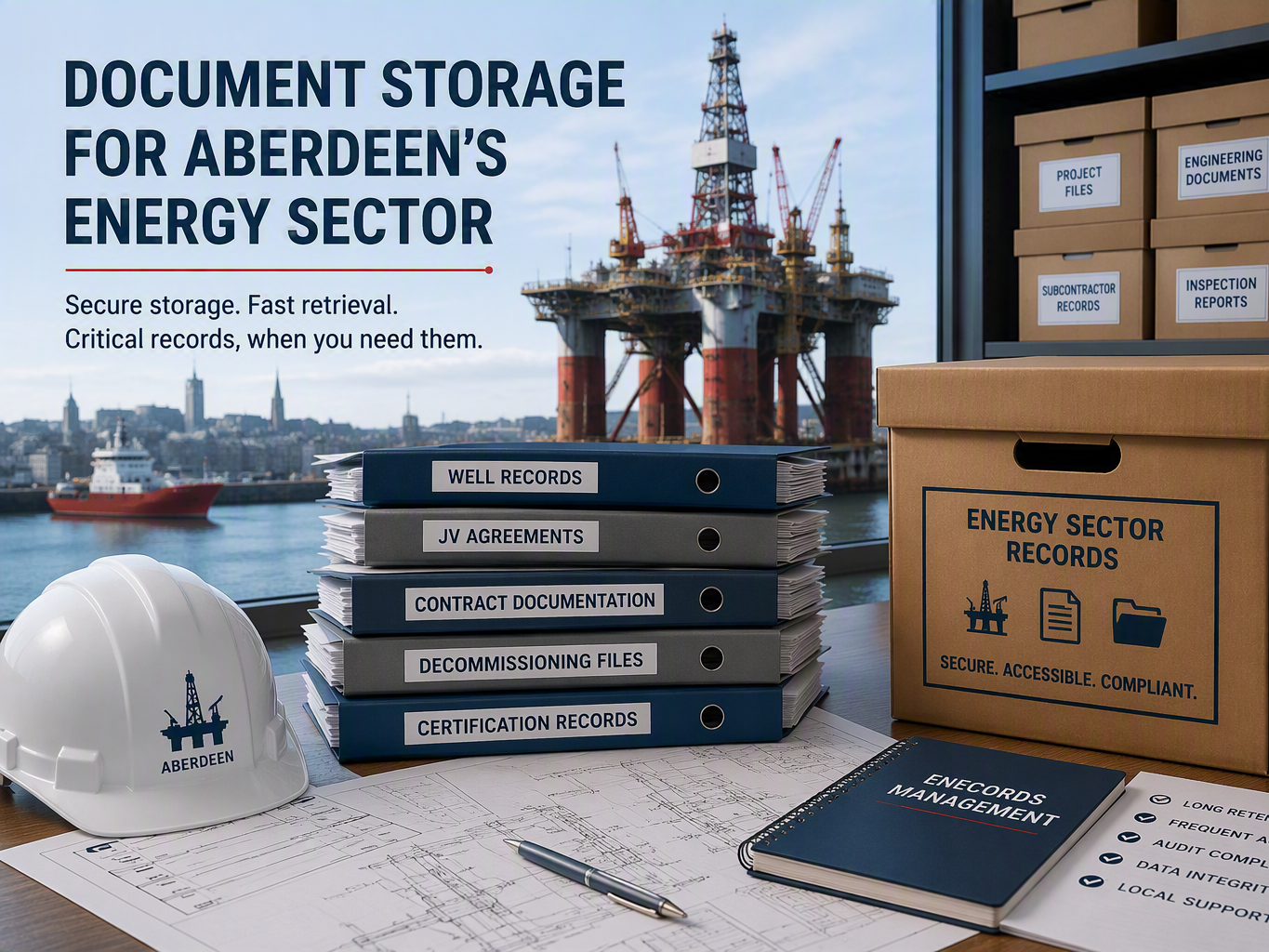
Aberdeen’s energy industry generates vast amounts of documentation. From well records and project files to certification paperwork and joint venture agreements, businesses often need to retain information for years, sometimes decades.
The challenge is not simply where to store it.
It’s how to keep it accessible.
For many organisations operating in the energy sector, archived records remain working assets long after a project is completed. Contracts need reviewing, technical information needs checking, and historical documentation is regularly requested during audits, inspections or commercial discussions.
That makes energy records management fundamentally different from storing files that may never be seen again.
Why Energy Companies Accumulate So Many Records:
The energy sector is documentation-heavy by necessity.
A single project can generate thousands of pages covering:
- Well records
- Engineering drawings
- Joint venture (JV) documentation
- Contracts and commercial agreements
- Procurement records
- Health and safety documentation
- Certification records
- Inspection reports
- Environmental information
- Personnel and contractor records
Many of these documents need to be retained long after active work has finished.
Over time, archives can grow from a few shelves of files into hundreds of boxes occupying valuable office space.
The Problem With Keeping Everything On Site:
Most businesses begin by storing records internally.
At first, this seems practical. Files remain close at hand and employees know where they are.
As archives grow, however, problems emerge:
- Office space becomes restricted
- Filing systems become harder to manage
- Historical records become dispersed across different locations
- Retrieval becomes slower
- Security and record control become more difficult
For Aberdeen energy companies operating from city-centre offices, every square metre has a purpose. Using valuable workspace for long-term archive storage is rarely the best use of space.
Why Energy Archives Are Rarely Truly Dormant:
In some industries, documents are retained solely for compliance purposes and may never be requested again.
The energy sector is different.
Records often continue to have operational value years after their creation.
Consider the types of requests that routinely arise:
Well and Asset Information
Historical documentation may be required to verify technical information, review previous work or support operational decision-making.
A project completed years ago can suddenly become relevant again.
Joint Venture Documentation
JV agreements often need to be referenced throughout the life of an asset.
When commercial questions arise, businesses need access to the original documentation quickly.
Contract Records
Contract terms, amendments and correspondence are frequently revisited during commercial reviews, disputes or procurement exercises.
Certification and Compliance Records
Inspection records, training certifications and contractor documentation may be needed at short notice during audits or compliance reviews.
In each case, the archive remains active even if the project itself has ended.
High Audit Exposure Means Fast Retrieval Matters:
Energy companies operate in one of the most heavily scrutinised sectors in the UK.
Organisations may be asked to produce information for:
- Internal audits
- Client audits
- Regulatory reviews
- Health and safety investigations
- Contractual reviews
- Due diligence exercises
- Insurance enquiries
When a request arrives, the ability to locate and retrieve the correct record becomes critical.
An archive is only useful if the required information can be found quickly.
This is why many businesses discover that retrieval speed matters far more than they originally expected.
What Good Energy Records Management Looks Like:
Effective energy records management is not simply about putting boxes on shelves.
It involves creating a system that allows records to remain accessible throughout their retention period.
Key elements typically include:
Accurate Indexing
Every box should be logged clearly and consistently.
Project names, contract references, asset information and retention details should be easy to locate when needed.
Without proper indexing, even relatively small archives become difficult to manage.
Controlled Storage
Records should be stored in a way that protects them from accidental loss, damage or misfiling.
Consistency is often more important than complexity.
Reliable Retrieval Processes
Businesses should understand:
- How files are requested
- Who handles retrievals
- How quickly records can be returned
- What happens when urgent access is required
Retention Management
Not every record needs to be kept forever.
A structured approach helps organisations identify which records should be retained and which can eventually be destroyed in accordance with internal policies and regulatory requirements.
An Aberdeen Perspective:
Aberdeen’s energy sector creates a particular challenge that businesses elsewhere may not face.
Many organisations have decades of accumulated paperwork connected to North Sea projects, subcontractor relationships, engineering works and commercial agreements.
An Aberdeen engineering consultancy, for example, might have records stretching back twenty years across hundreds of projects.
A contractor working across offshore assets may need access to certification records going back many years.
A company involved in decommissioning activities may regularly revisit archive material relating to projects that began long before decommissioning was ever contemplated.
In these situations, records are not historical curiosities.
They remain part of the day-to-day operation of the business.
Why Local Storage Can Make Sense:
When historical documentation is regularly accessed, location becomes increasingly important.
A local archive can support:
- Faster retrieval
- Easier communication
- Quicker response to urgent requests
- Better support during audits or project reviews
For organisations based in Aberdeen, local storage can mean the difference between treating archived files as accessible working information and treating them as something difficult to obtain.
That distinction matters when deadlines are tight and information is needed quickly.
Questions Energy Businesses Should Ask a Storage Provider:
Before appointing a provider, consider asking:
- How quickly can records be retrieved?
- Is same-day access available?
- How are records indexed?
- Who physically handles the boxes?
- What happens if documents are needed urgently?
- Is there a minimum contract term?
- Can records be viewed without being removed from storage?
- How are documents destroyed when retention periods expire?
- Does the provider regularly support businesses with active archives?
These questions often provide a clearer picture of service quality than discussions about storage capacity alone.
Storage Is Important. Access Is Essential.
The energy sector’s paperwork rarely disappears into storage and stays there forever.
Well records, contract files, certification documents and project archives continue to generate value long after they leave the office.
That means businesses should think carefully about the kind of storage provider they choose.
For dormant records that are unlikely to be accessed, deep storage may be entirely appropriate.
For active archives that support audits, compliance reviews, engineering projects and commercial decision-making, accessibility becomes the priority.
Because in the energy industry, the real value of an archive is not where it is stored.
It’s how quickly you can get the information back when you need it.
Related Reading:
If you’re reviewing records management arrangements, these related articles from our Journal may also be useful:
- Is Your Archive Active or Dormant?
- Ten Questions to Ask Before Signing a Document Storage Contract
- Why Local Matters: Secure, Flexible Document Storage in the Heart of Aberdeen
- How to Build a Document Retention Policy That Works
- 5 Signs It’s Time to Move Your Files Offsite
- What Happens To Your Documents When You Run Out of Space?
United Supplies Document Storage has been serving Aberdeen businesses since 1973. If your organisation is managing project archives, certification records or long-term energy sector documentation, get in touch for a tailored quotation and practical advice on archive management.