
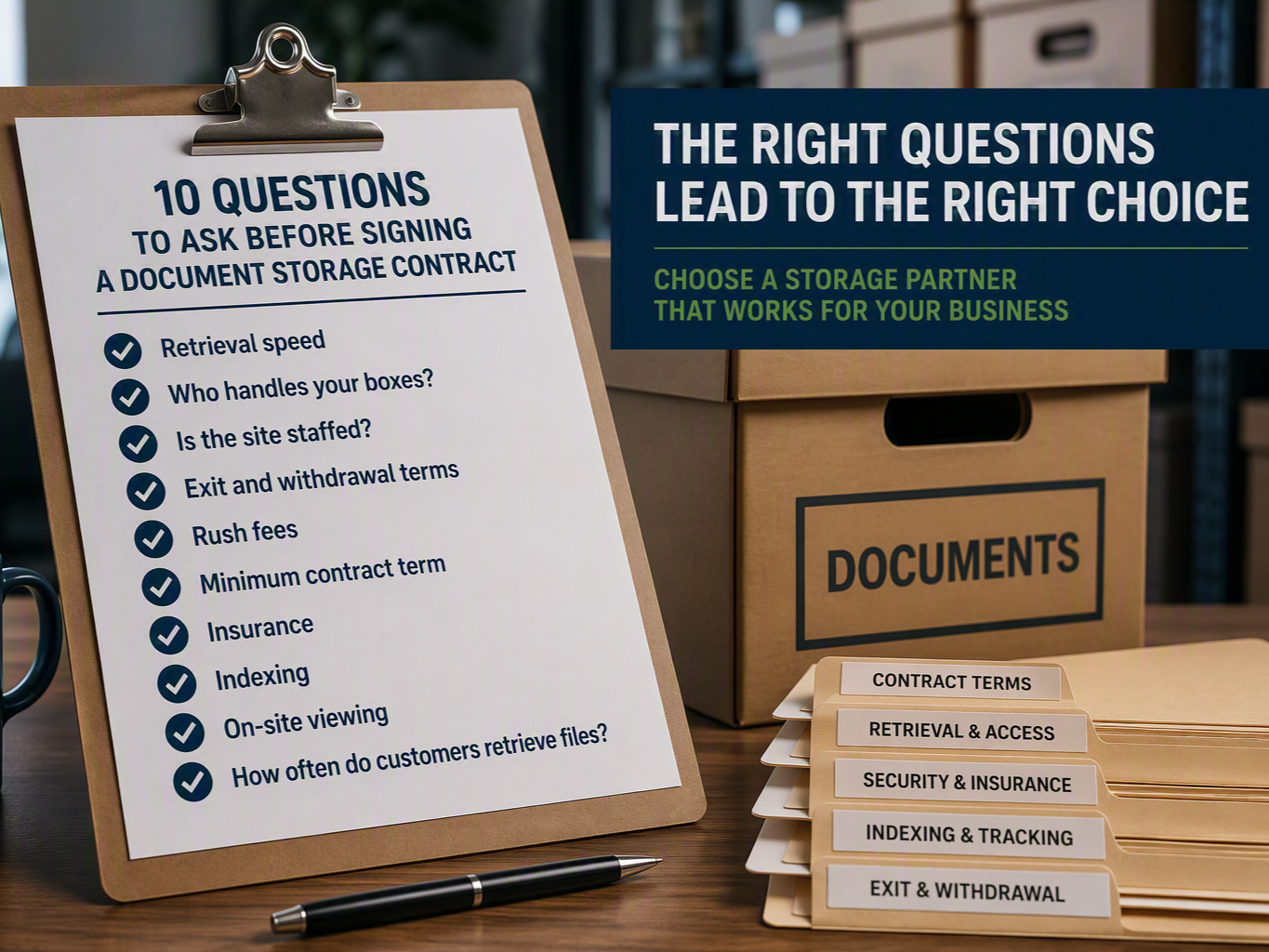
Choosing a document storage company can seem straightforward. Your files are collected, stored securely and retrieved when needed.
In reality, the quality of document storage services can vary considerably, particularly when it comes to access, responsiveness and contract terms. Two providers may both offer off-site document storage, yet deliver very different experiences when you need a file returned.
Before signing a document storage, it is worth asking a few practical questions. The answers will tell you far more than a sales brochure ever will.
1. How Quickly Can You Retrieve My Files?
This should be the first question on your list.
Many businesses only discover the importance of retrieval speed after their files have been moved off-site. A storage provider may offer attractive terms for storing boxes, but what happens when you need information back urgently?
Ask:
- Is same-day retrieval available?
- What is the typical response time?
- What happens if a file is required urgently?
- Is retrieval guaranteed?
For businesses with active archives, retrieval speed is often more important than storage itself.
A solicitor preparing for a court appearance, an accountant responding to a client query or an engineering company reviewing project records rarely benefits from knowing where a document is stored. They benefit from getting it back quickly.
2. Who Physically Handles My Boxes?
Not all storage operators work in the same way.
Some providers handle collections, storage and retrieval using their own staff. Others rely on third-party contractors for parts of the process.
It is worth understanding:
- Who collects your records?
- Who retrieves them?
- Who delivers them back?
- How many different organisations have access to your archive?
The fewer handovers involved, the easier it becomes to maintain accountability and consistency.
3. Is the Storage Facility Staffed?
A surprisingly important question.
A staffed facility generally allows for quicker retrievals, more responsive customer service and easier handling of urgent requests.
Ask:
- Are staff present throughout normal business hours?
- Can requests be processed immediately?
- Who do you contact if you need assistance?
For organisations that access files regularly, a staffed warehouse can make a significant difference to service levels.
4. What Are the Exit and Withdrawal Terms?
Most businesses focus on moving documents into storage.
Far fewer think about what happens when they need them back permanently.
You should understand:
- Can files be withdrawn at any time?
- Is there a notice period?
- What happens if you decide to move provider?
- How is a full archive return managed?
A document storage contract should not make it difficult to access your own records.
Clear withdrawal arrangements are often a sign of a provider that is confident in its service.
5. Are There Additional Charges for Urgent Requests?
Not every retrieval request arrives with several days’ notice.
Sometimes a business receives an urgent request from a client, auditor, regulator or legal adviser and needs information immediately.
Ask:
- What qualifies as an urgent retrieval?
- Are rush services available?
- Are there additional fees for priority requests?
Even if urgent requests are rare, it is useful to understand how the provider manages them before you need one.
6. Is There a Minimum Contract Term?
Some storage providers require customers to commit for fixed periods.
Others offer more flexibility.
Questions worth asking include:
- Is there a minimum contract term?
- Can storage requirements increase or decrease?
- What happens if we need less space in future?
- Are monthly arrangements available?
Business requirements change. A contract that works today may not be the right fit two years from now.
Flexibility is often particularly valuable for growing businesses, project-based organisations and firms managing office moves.
7. How Is My Archive Indexed?
A storage provider can only retrieve documents efficiently if they know exactly where they are.
This makes indexing one of the most important parts of records management.
Ask:
- How are boxes logged?
- Can individual files be indexed?
- How are retrieval requests identified?
- Can records be tracked throughout their lifecycle?
An archive containing hundreds of boxes becomes much easier to manage when records are properly indexed from the outset.
Without good indexing, retrieval becomes slower and administrative effort increases.
8. What Insurance Arrangements Are in Place?
Insurance is not always discussed during the buying process, but it should be.
Questions to ask include:
- Is the facility insured?
- What protection exists against fire, flood or accidental damage?
- Are customer records covered?
- Are there limits to any cover provided?
Understanding these arrangements helps ensure there are no surprises later.
9. Can Documents Be Viewed Without Being Removed?
Retrieving files is not always the only option.
In some situations, businesses want to review records without taking them back into the office.
Examples include:
- Legal reviews
- Historical research
- Due diligence exercises
- Archive assessments
Ask whether the provider offers:
- On-site viewing facilities
- Private viewing rooms
- Access by appointment
This can be a useful alternative to removing boxes entirely from storage.
10. How Often Do Your Customers Actually Retrieve Files?
This final question often reveals the type of storage provider you are dealing with.
Some companies are designed primarily for dormant archives. Their customers may rarely request documents.
Others support active archives where files move in and out regularly.
Neither model is inherently better, but they serve different needs.
If your organisation regularly accesses historical records, it makes sense to choose a provider that is accustomed to handling frequent retrieval requests.
The answer will tell you a great deal about how the service is designed to operate.
Choosing a Document Storage Company: Look Beyond Storage
When assessing document storage contracts, it is easy to focus on boxes, shelf space and paperwork.
The more important questions are usually operational.
How quickly can files be returned?
How easy is the service to use?
What happens when circumstances change?
And how accessible will your archive be six months or six years from now?
For businesses with active archives, access, responsiveness and flexibility often have a greater impact on day-to-day operations than the storage itself.
The best provider is not necessarily the one with the lowest headline cost. It is the one whose service matches the way your organisation actually uses its records.
Related Posts:
If you’re reviewing your archive arrangements, these articles may also be helpful:
- Is Your Archive Active or Dormant?
- How to Build a Document Retention Policy That Works
- Why Local Matters: Secure, Flexible Document Storage in the Heart of Aberdeen
- 5 Signs It’s Time to Move Your Files Offsite
- Preparing for an Office Clear-Out
United Supplies Document Storage has helped Aberdeen businesses manage their records since 1973. If you’re considering a new document storage provider and would like practical advice on retrieval, indexing or archive management, get in touch for a tailored quotation.