
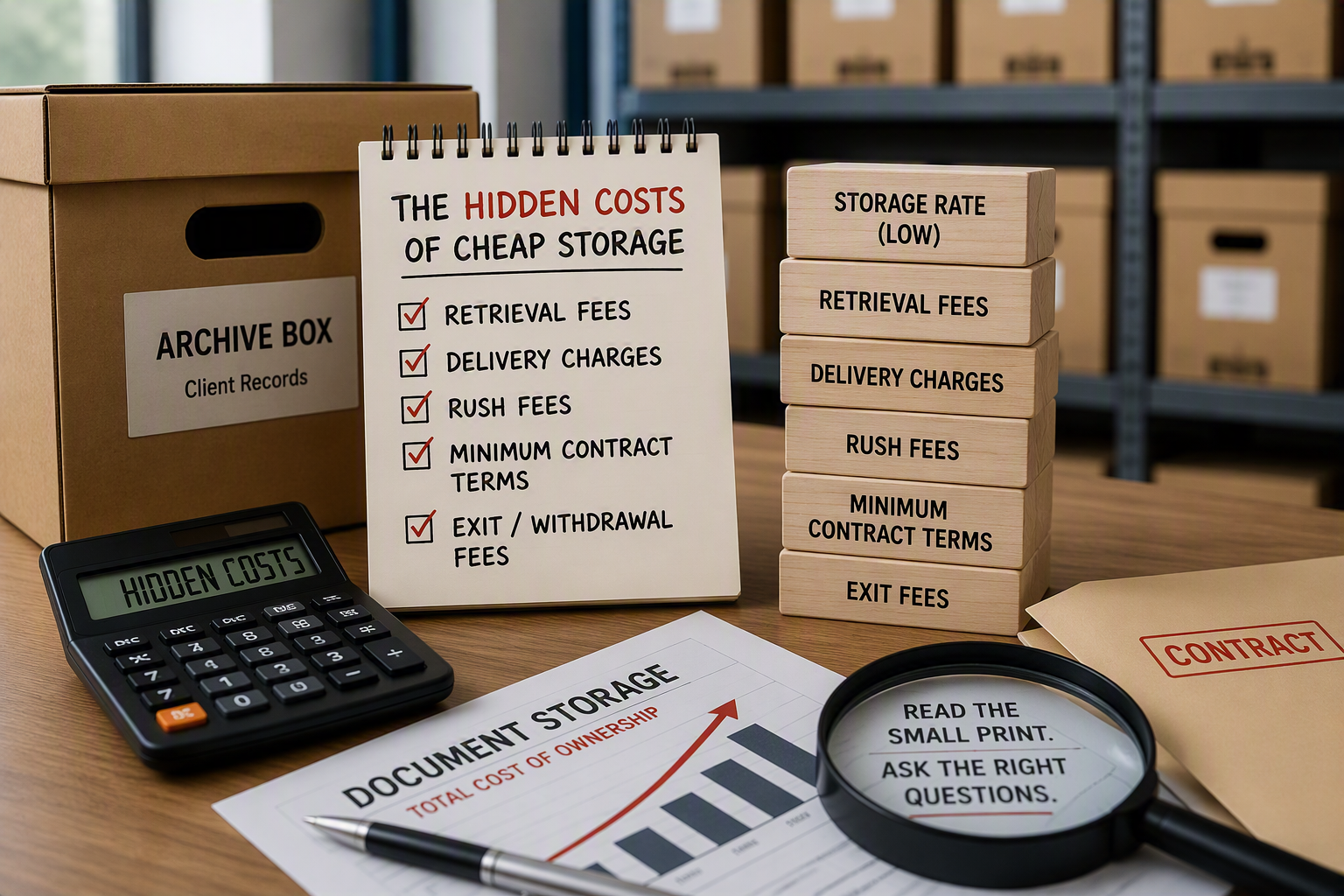
Cheap document storage can prove expensive once retrieval fees, delivery charges, contract terms and exit costs are taken into account. Learn the questions every business should ask before choosing a provider.
When businesses compare document storage providers, the first figure they tend to notice is the storage rate.
That is understandable. On the surface, document storage appears to be a simple service. A provider collects archive boxes, stores them securely and charges a fee to keep them there.
The problem is that the headline storage rate often tells only part of the story.
In the document storage industry, low storage charges are frequently balanced elsewhere. The real cost of a service may only become apparent when you need a file returned, a box delivered, a contract changed, or your records back altogether.
For businesses with live, working archives, understanding these costs is essential.
The question is not whether a storage provider is cheap.
The question is whether the service remains good value once you start using it.
Why Headline Prices Can Be Misleading:
Imagine two document storage providers.
Provider A charges a low monthly storage rate.
Provider B charges a higher monthly storage rate.
At first glance, Provider A appears to be the obvious choice.
However, document storage is not simply about keeping boxes on shelves. Most businesses need additional services throughout the life of the contract.
A file needs to be retrieved.
A box needs delivered.
A department requests archive records.
A compliance review takes place.
A subject access request arrives.
Once those activities begin, the true cost of the arrangement becomes clearer.
That is why businesses should look beyond storage fees and consider the total cost of using the service over time.
Retrieval Fees – The Cost Nobody Notices at the Start:
One of the most common charging mechanisms in the industry is the retrieval fee.
On paper, a storage contract can appear highly competitive because the cost of storing a box is kept low.
The provider then charges separately whenever a box, file or document needs to be retrieved.
For organisations with genuinely dormant archives, that may not matter.
But many businesses do not have dormant archives.
A solicitor may need a client file.
An accountant may require historic records.
An engineering consultancy may need documents relating to a completed project.
A healthcare provider may need access to archived paperwork.
When records continue to be used, retrieval activity becomes part of normal business operations.
A storage arrangement that looks economical when viewed solely as a storage service can feel very different when files are being requested every month.
Delivery Charges Can Quickly Add Up:
Retrieval is only part of the picture.
The file then needs to reach the client.
Some providers separate retrieval from delivery, meaning that obtaining access to records involves multiple charges rather than one.
Businesses often discover this only after records are already in storage.
The practical issue is straightforward.
Every archived document is valuable only when it can be accessed.
If records are regularly being returned to the office, delivery arrangements become just as important as storage arrangements.
Before signing any contract, it is worth asking:
- How are retrieved files delivered?
- How quickly are they delivered?
- Is delivery included within the service model?
- What happens when access is urgent?
The answers can have a significant impact on overall costs and operational efficiency.
What Happens When You Need Records Urgently?
Not every retrieval request is planned.
Sometimes a deadline appears unexpectedly.
A regulatory enquiry arrives.
An audit begins.
A legal matter requires historic records.
An employee submits a subject access request.
In situations like these, waiting several days for standard retrieval may not be practical.
Many providers therefore offer expedited retrieval services.
The important question is whether rapid access forms part of the normal service or whether it exists as a premium option.
Businesses with active archives should understand this distinction before moving records offsite.
An urgent retrieval is rarely optional. If a file is needed, it is needed.
Minimum Contract Terms Can Reduce Flexibility:
Another factor that’s frequently overlooked is contract length.
Some storage arrangements are built around lengthy minimum terms.
Again, this may not seem important during procurement.
Circumstances change, however.
Businesses relocate.
Departments grow.
Digitalisation projects reduce archive requirements.
Acquisitions occur.
Retention periods expire.
A storage requirement that makes complete sense today may look very different in two or three years.
Flexible arrangements give organisations room to adapt as their needs change.
Long contractual commitments can make that process more difficult than expected.
The Question Many Buyers Forget to Ask:
There is one question that surprisingly few businesses ask when choosing a document storage provider:
What happens if we want our records back?
Most conversations focus on collection and storage.
Eventually, however, many organisations need to recover some or all of their archives.
That could happen because:
- The business relocates records internally.
- A retention project concludes.
- Documents are being digitised.
- A division is sold.
- Another provider is selected.
- Records are required for operational use.
At that point, the withdrawal process becomes important.
And sometimes expensive.
Understanding Exit Fees:
Exit fees, sometimes referred to as permanent withdrawal charges, are among the least discussed aspects of document storage.
Yet they can have a major impact on overall costs.
The principle is simple.
Moving boxes into storage is only half of the journey.
One day those boxes may need to come back out.
Some providers apply charges when records leave storage permanently.
From the provider’s perspective, this can help offset an initially low storage rate.
From the client’s perspective, it can make changing arrangements more difficult than anticipated.
The important point is not whether such charges exist.
The important point is whether they are understood before a contract begins.
A storage service should be evaluated based on its entire lifecycle, from collection through to eventual withdrawal.
Looking at Total Cost Instead of Cost Per Box:
Businesses often compare storage providers using a single measure: the storage cost per box.
While understandable, this approach can overlook the factors that matter most.
Consider two organisations with 400 archive boxes.
One retrieves records only once a year.
The other retrieves eight to ten files every month and regularly requires archive access.
Although both organisations store the same number of boxes, their needs are completely different.
The second organisation should place much greater emphasis on access, retrieval performance, responsiveness and flexibility.
In other words, the cheapest storage provider is not automatically the lowest-cost provider.
The true comparison is total cost over the lifetime of the relationship.
Questions Every Buyer Should Ask:
Before choosing a document storage provider, ask:
- How quickly can records be retrieved?
- Are there separate retrieval charges?
- How are deliveries handled?
- What happens when access is urgent?
- Is there a minimum contract term?
- What is the process for permanently withdrawing records?
- Are there charges when boxes leave storage?
- How often do existing clients typically access their archives?
- Is the service designed for active archives or dormant archives?
These questions often reveal far more than a headline storage figure ever will.
Final Thoughts:
Document storage is not simply about putting boxes into a warehouse.
It is about being able to access important records when your business needs them.
The cheapest-looking option is not always the most economical option once retrievals, deliveries, contract restrictions and exit arrangements are taken into account.
For organisations with live, working archives, the better question is not:
“How much does storage cost?”
It is:
“How easy will it be to get our records when we need them?”
Because the real value of a document storage service is usually measured not when your boxes go into storage, but when you need them back.
Contact Us:
If your organisation regularly accesses archived records, choose a storage arrangement built around retrieval, responsiveness and flexibility. United Supplies Document Storage has been serving Aberdeen businesses since 1973, with a city-centre warehouse, same-day retrieval guaranteed, and most collections and deliveries completed within the hour. Contact us to discuss your requirements.