
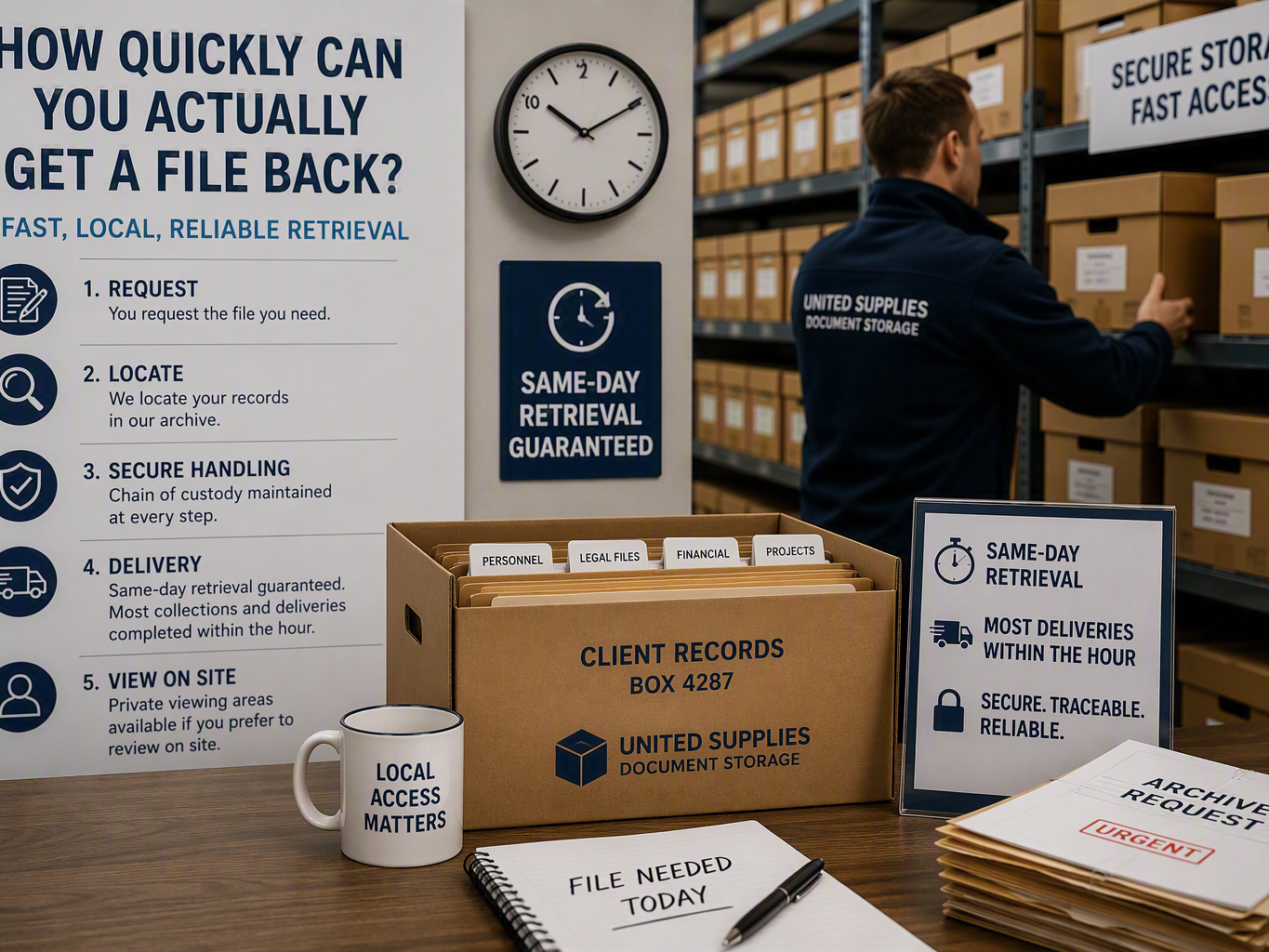
How long does document retrieval really take? Learn what happens between a retrieval request and delivery, and why retrieval speed matters for Aberdeen businesses with active archives.
One of the biggest concerns businesses have about moving records offsite is also one of the most sensible.
What happens when we need something back?
Most organisations understand the benefits of offsite document storage. It frees up office space, improves organisation and helps manage records more effectively.
But none of those advantages matter if retrieving a file becomes difficult.
Whether it’s a client file, personnel record, archived project documentation or historical correspondence, businesses need confidence that important information remains accessible when required.
The good news is that retrieving a file from storage is usually straightforward.
The important difference lies in how long it takes.
Why Retrieval Time Matters:
Many archived records are not truly dormant.
They may be years old, but they still play an active role in the business.
A solicitor may need to review a concluded matter.
An accountant may need historic financial records.
A healthcare provider may require archived documentation.
An engineering consultancy may need project files from several years ago.
The file itself may have left the office, but it has not necessarily left day-to-day operations.
When organisations talk about document storage, discussions often focus on security, retention and storage capacity.
In practice, retrieval speed is often just as important.
After all, a document is only useful if you can access it when you need it.
What Actually Happens When You Request a File?
Many people imagine document retrieval as a simple process.
A request is made.
A box is located.
The document is delivered.
While the principle is straightforward, there are several important steps involved behind the scenes.
Step 1: The Retrieval Request
The process begins when a client contacts their storage provider.
This may be:
- A request for a specific file
- A request for an archive box
- A request for multiple records
- An urgent compliance-related requirement
- A request to view documents on site
The more accurately records are indexed and catalogued, the more efficient this stage becomes.
A well-managed archive should allow items to be identified quickly and accurately.
Step 2: Locating the Records
Once the request is received, archive staff locate the relevant records.
This is where storage systems become important.
Every box should be uniquely identified and traceable.
The aim is not simply to find the documents, but to ensure the correct documents are retrieved.
For organisations handling legal, financial, medical or personnel records, accuracy matters just as much as speed.
A retrieval process should provide confidence that the chain of custody remains clear throughout.
Step 3: Verification and Chain of Custody
Before documents leave storage, records are checked and logged.
This creates a clear audit trail showing:
- What was requested
- What was retrieved
- When it was retrieved
- Who handled it
- When it was returned or destroyed
For sensitive documentation, maintaining a documented chain of custody is an important part of responsible records management.
Businesses should always know where their information is and who has handled it.
Step 4: Delivery or Collection
Once records have been retrieved and verified, they are prepared for delivery.
This is often the stage where storage providers differ most significantly.
Some providers operate local delivery routes.
Others may be retrieving records from facilities located many miles away from the client.
The further away records are stored, the longer retrieval generally takes.
That may not matter for archives that are rarely accessed.
For active archives, however, retrieval time can become a critical factor.
Why Storage Location Matters:
When businesses compare document storage providers, they understandably focus on security and space.
Location can sometimes feel less important.
Yet location often determines how quickly records can be returned.
Consider two different storage models.
A Local Aberdeen Archive
Documents are stored within Aberdeen.
Requests are handled locally.
Records are retrieved nearby and delivered directly.
The physical distance between archive and client is relatively short.
A Regional or National Archive
Documents may be stored in a centralised warehouse serving multiple locations.
Retrieval requests may be processed through a larger operational system.
Records often need to travel further before arriving with the client.
Neither approach is inherently right or wrong.
The key question is whether the retrieval times match the needs of the business.
For organisations regularly accessing archived records, proximity can make a significant difference.
The Difference Between Same-Day and Multi-Day Retrieval:
Many storage providers can retrieve records.
The more useful question is:
How quickly can they retrieve them?
If archived records are required to support an active business process, waiting several days may not be ideal.
Examples include:
- Subject access requests
- Regulatory enquiries
- Employment matters
- Legal file reviews
- Audit preparation
- Client requests
- Historic project reviews
In these situations, access speed becomes part of operational performance.
A retrieval measured in hours creates a very different experience from a retrieval measured in days.
That distinction often becomes apparent only after records have entered storage.
When Viewing Documents Is Better Than Removing Them:
Not every archive request requires documents to leave storage.
Sometimes clients simply need to examine records.
This is particularly useful when:
- Reviewing large volumes of files
- Identifying records for destruction
- Inspecting specific historical documents
- Conducting archive audits
- Preparing retention reviews
In these circumstances, on-site viewing facilities can be extremely useful.
Instead of transporting multiple boxes back and forth, documents can be examined securely within the storage facility itself.
For some organisations, this proves to be the quickest and most practical approach.
Questions to Ask About Retrieval Before Choosing a Provider:
Businesses often spend considerable time discussing storage arrangements.
Less attention is given to retrieval.
That is a mistake.
Before selecting a provider, consider asking:
- How quickly can a file be retrieved?
- Is same-day retrieval available?
- Where are the records physically stored?
- What happens if access is urgent?
- Can files be viewed on site?
- How is chain of custody maintained?
- How are records tracked throughout the retrieval process?
- Is the service designed for active archives or long-term inactive storage?
The answers will often tell you more about the practical value of the service than discussions about storage space alone.
Access Is the Real Test of a Storage Service:
Putting documents into storage is easy.
The real test comes later.
A client calls unexpectedly.
An audit begins.
A compliance deadline appears.
A historic file is suddenly required.
At that point, businesses discover whether they bought document storage or document access.
For organisations with live, working archives, the difference matters.
A storage service should not merely keep records safe.
It should make them available when they are needed.
Final Thoughts:
Offsite document storage only works if records remain accessible.
Every provider can offer storage space. Fewer can offer genuinely responsive retrieval when a business needs information quickly.
That is why retrieval times deserve as much attention as security, retention and storage capacity.
Before choosing a provider, ask a simple question:
How quickly can you actually get a file back?
Because sooner or later, every archive box stops being a box on a shelf and becomes a document somebody urgently needs.
Contact Us:
United Supplies Document Storage has been serving Aberdeen businesses since 1973 from a city-centre warehouse. Same-day retrieval is guaranteed, most collections and deliveries are completed within the hour, and private viewing facilities are available on site. If your organisation relies on active archives, contact us to discuss a storage service built around access as well as security.