
When businesses start looking for off-site document storage, the conversation often begins with cost. How much space do we need? How many boxes are there? What does storage cost per month?
Those are reasonable questions, but they overlook something more important:
How often do you actually need your files back?
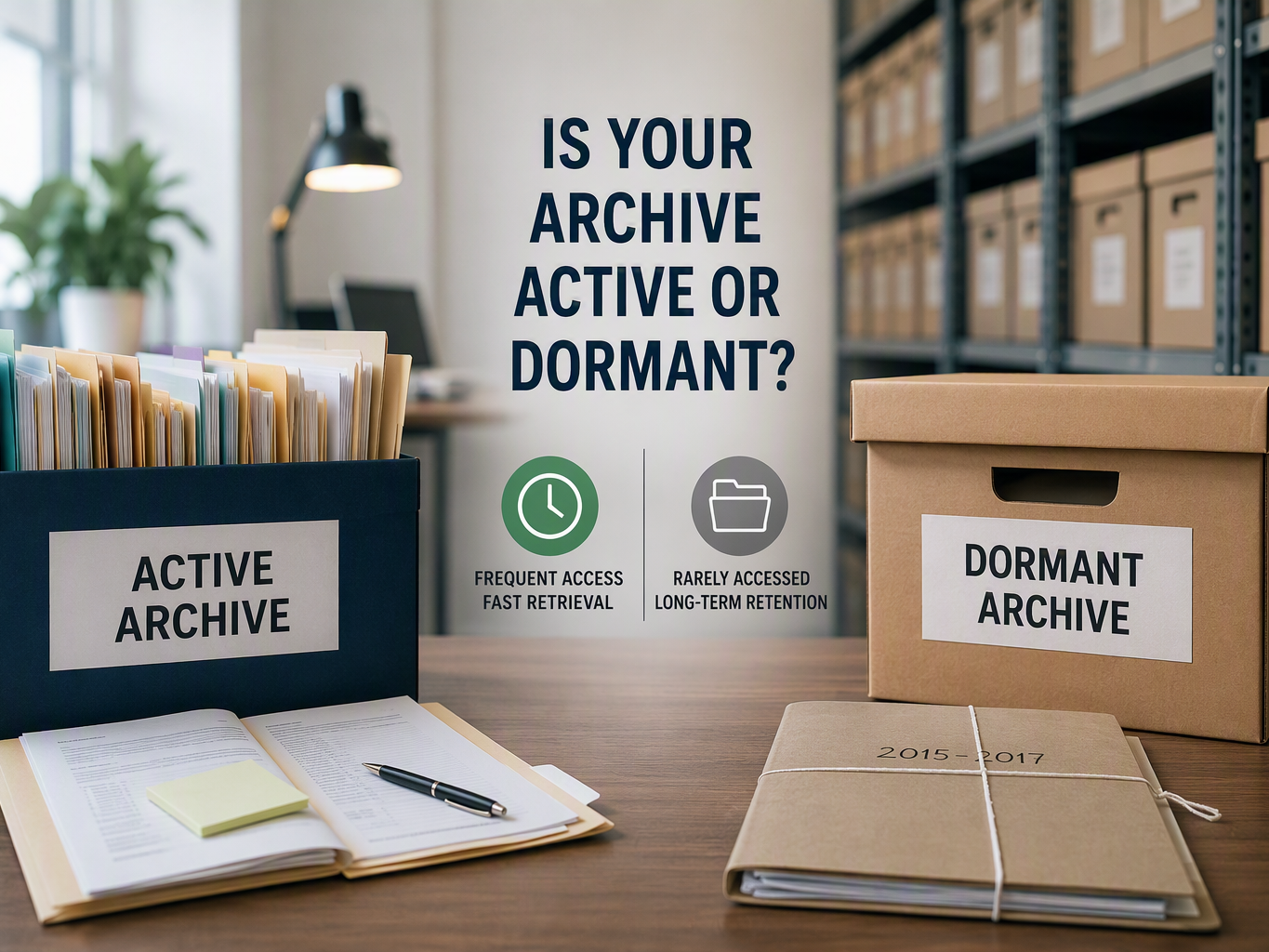
The answer determines what kind of storage provider is right for you. In practice, most business archives fall into one of two categories: dormant archives and active archives.
Understanding the difference can save time, reduce frustration, and help you choose a service that matches the way your organisation works.
What is a Dormant Archive?
A dormant archive contains records that are retained primarily for legal, regulatory or historical reasons but are rarely accessed.
Examples might include:
- Financial records kept to satisfy HMRC requirements
- Closed project files
- Historical personnel records
- Legacy business documents
- Archived correspondence
In these situations, boxes can often remain untouched for years at a time.
A business might retrieve a file once every few months, or not at all.
If that describes your archive, it is worth saying something that many storage providers do not:
You may not need a retrieval-focused document storage service.
If your records genuinely sit untouched for long periods, a low-cost deep-storage model may be entirely appropriate. Many national operators are designed around exactly this type of archive. Their facilities, processes and pricing structures assume documents are stored for long periods and rarely leave the shelf.
For dormant archives, that can be a sensible fit.
What is an Active Archive?
An active archive is different.
The records are no longer needed in the office every day, but they remain part of the normal running of the business.
Files move in and out regularly. Staff expect access when required. Delays create operational problems.
Examples include:
- Solicitors retrieving files relating to ongoing matters
- Medical practices accessing retained records
- Accountants reviewing historical client information
- Engineering firms revisiting project documentation
- Property businesses checking previous transactions
- Organisations responding to information requests
In these cases, storage is only part of the service.
Access becomes the critical factor.
A Simple Test
Ask yourself:
- How often do we retrieve files?
- Have we requested anything from storage in the last month?
- Would a two or three day wait cause problems?
- Do staff regularly need historical records?
- Are retrieval requests predictable or urgent?
The more “yes” answers you give, the more likely you have an active archive rather than a dormant one.
Why Active Archives Need a Different Approach
Many businesses begin by assuming all document storage providers offer roughly the same service.
The reality is that providers often optimise for completely different priorities.
A deep-storage operation is designed to hold large volumes of documents efficiently.
An active archive service is designed to get documents back to you quickly.
Those may sound similar, but they lead to very different ways of working.
Consider an Aberdeen engineering consultancy with around 400 archive boxes. The records are no longer needed in the office every day, but project information is routinely revisited when questions arise on completed works.
If the company retrieves eight to ten files every month, the storage fee is only one part of the equation.
The bigger question is:
How easy is it to get those files back when they are needed?
The Hidden Cost of Slow Retrieval:
Businesses often focus on the visible cost of storage while overlooking the operational cost of waiting.
A delayed file can mean:
- Staff spending time chasing information
- Delayed responses to clients
- Slower decision-making
- Difficulty preparing for audits
- Pressure when responding to regulatory requests
For organisations with active archives, retrieval speed quickly becomes more important than the storage itself.
The file sitting safely on a shelf is only valuable if it can be accessed when required.
How Often Do You Access Your Files?
There is no universal rule, but retrieval frequency is usually the easiest way to assess what type of archive you have.
Typically Dormant
- No retrievals for years
- Documents held purely for retention purposes
- Files rarely requested internally
- Long lead times acceptable
Typically Active
- Monthly retrieval requests
- Weekly requests
- Ongoing case or project work
- Compliance obligations requiring prompt access
- Unexpected requests from customers, auditors or regulators
Most businesses know instinctively which category they fall into.
The challenge is making sure their storage provider is set up for that reality.
Active Archive Storage is About Access:
The phrase active archive storage can sound contradictory.
After all, if records are active, why not keep them in the office?
The answer is usually space.
Many businesses need to free up valuable office areas without losing access to important information.
Active archive storage provides that balance.
Records move off-site, office space is recovered, and files remain available when needed.
This approach is particularly common in sectors such as legal, medical and financial services, where documents may need to be retained for many years but still require occasional access.
Questions to Ask Any Storage Provider:
Before choosing a provider, ask:
- How quickly can a file be retrieved?
- What happens if we need something urgently?
- Are documents stored locally?
- Can we view files on site if required?
- How are collections and deliveries handled?
- Is there a minimum contract term?
- How often do your customers typically retrieve records?
These questions will often tell you more than any marketing brochure.
A provider designed for dormant archives may be an excellent choice for long-term deep storage.
A provider supporting active archives should be able to explain clearly how retrieval works and what level of access clients can expect.
The Aberdeen Advantage of Keeping Archives Local
For businesses in Aberdeen and the surrounding area, location can make a significant difference.
When records are stored locally, retrieval is generally simpler than when files are held at facilities much further afield.
That matters when an accountant needs historical records for a client meeting, a solicitor requires a case file, or a business receives an unexpected request for information.
The closer the archive is to the people using it, the easier it becomes to treat stored records as a working business resource rather than a forgotten box on a shelf.
So, Is Your Archive Active or Dormant?
There is no right or wrong answer.
Some archives really are dormant, and for those organisations the cheapest deep-storage option may be perfectly suitable.
But if files move in and out regularly, if staff depend on access to historical records, or if delays create problems, then storage alone is not enough.
You need a provider built around retrieval, responsiveness and access.
Because for an active archive, the important question is not where the file is stored.
It’s how quickly you can get it back.
If you’re reviewing your current archive arrangements and want to discuss how often your records are actually accessed, United Supplies Document Storage has been serving Aberdeen businesses since 1973. Get in touch for practical advice and a tailored quotation based on the way your archive works.
The answer determines what kind of storage provider is right for you. In practice, most business archives fall into one of two categories: dormant archives and active archives.